
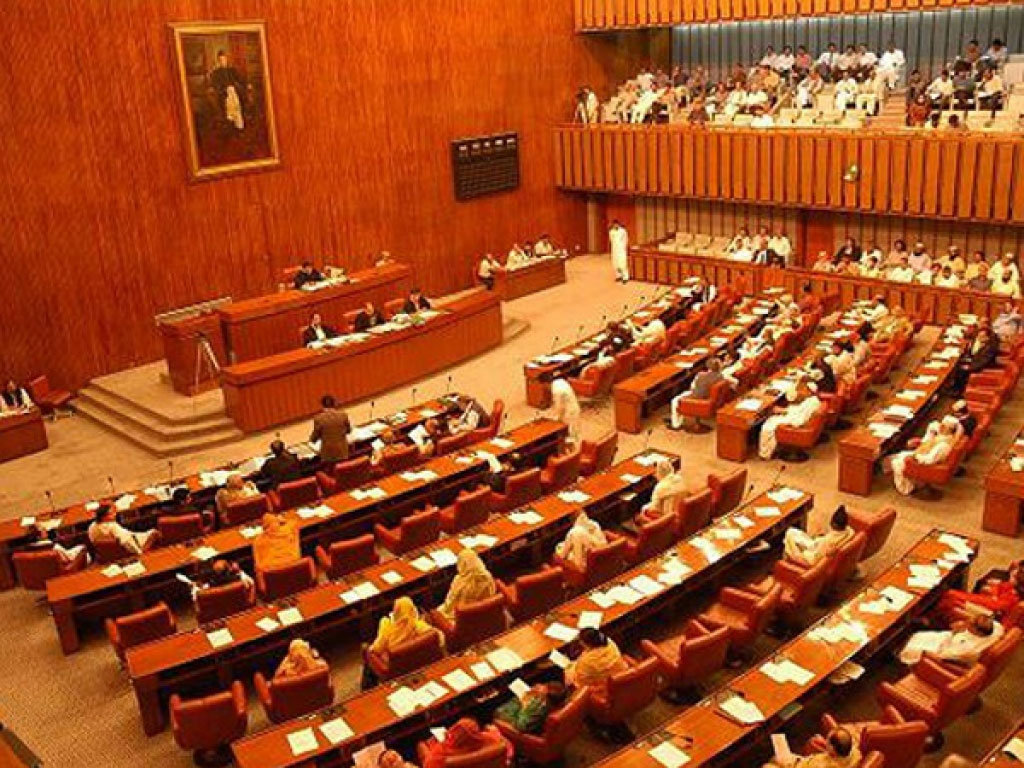
How unfortunate it is that the current National Assembly is yet to pass any legislation. Elected on August 13, the only mentionable feat it has so far performed is the passage of the money bill, to which there was no escape. The much-touted justification that in a working parliament the Opposition must oppose everything and propose nothing is valid. But, presently not in our case, because on the face of it, ours' is not a working parliament. However, things are likely to change. Last month, as the government relented on its otherwise untenable stand on the election of Public Accounts Committee chairman, the Opposition welcomed it as a "positive U-turn" on the part of the prime minister. But then this was also a challenge to the Opposition to play the game by taking further the business of the house. The obvious next step was formation of house committees, which are not there in violation of rules under which the Speaker is bound to constitute all standing and functional committees "within 30 days after election of the Leader of the House". Since Imran Khan was elected Leader of the House, and became Prime Minister on August 17 this errand should have been completed by September 17. But that has not been done, forcing Speaker of the House, Asad Qaiser, to once again pull up his sleeves and cajole the two sides of the aisle to join hands in order to complete the process of formation of 38 standing committees. One such attempt was made this past Thursday, but this too apparently failed to bear fruit. Who should get what? This is the main hurdle to formation of committees. While the Speaker is anxious to come up to a lot of expectations the powerful desire nurtured by leaders on both sides for the chairmanships of important committees like interior, finance and foreign affairs stands in the way. Since a committee chairperson is not veto-empowered dragging feet by the Opposition on the issue of formation of committees remains enigmatic.
Is it then a case that the Opposition's only goal is to send packing the PTI-headed government whatever it takes? Simply stated, the people voted the PTI into power, and also decided that the PML(N)-headed Opposition should sit on the Opposition benches. That election was rigged massively is the Opposition's consistently refrain. That National Accountability Bureau (NAB) is conducting one-sided accountability is also Opposition's slogan. But there are relevant platforms where these concerns can be raised; and to some extent have been raised by the Opposition. And that done the Opposition must sit in the National Assembly to help generate working ambience and forcefully present its position on all such issues. It would gel with the people at large. Conceded, to topple a sitting government by a count of vote is acceptable, and also given that government's majority in the National Assembly being marginal to vote it out may be a tempting enterprise on the part of the Opposition. But more important than all of it is the basic democratic norm that casts the Opposition in the role of the other wheel of cart loaded with people's hopes and demands. One such demand underscores the need for updating the colonial vintage legal system. Had there been timely legislations there would have been less and less suo motu court proceedings. And, had the parliament enacted a law to amend the National Accountability Ordinance (NAO) there would not have been this uproar against NAB's custodial powers. The bitter reality is that our successive parliaments failed to deliver on people's hopes and aspirations.